Showing posts with label Marsh Harrier. Show all posts

Wednesday, 25 May 2016

'Among The Reedbeds'


Having only ever had a taster of the Somerset levels from a brief Saturday visit earlier in the year and with no autumn holiday previously booked, it seemed like a great place to get away too for a few days as a change of scenery without having to travel too far. My previous visit to the RSPB’s Ham Wall reserve had been late on a March afternoon and although promised much, the weather came in and sightings were at a minimum. So having the opportunity to visit again with a bit more time on my hands was a promising prospect.

Unfortunately the weather was very similar to last time with most afternoons grey and overcast, although this time the wildlife on show was a lot more obliging. Working a 9-5 weekday job doesn’t often bring the chance of visiting reserves during the week. But oh how I wish I could do that more often, there were hardly any people around and those that were, were there for the wildlife and not to walk the dog or keep the kids entertained like the usual weekend crowd I encounter.

It didn’t take too long as I entered the reserve before I got a glimpse of a Somerset levels specialist, a very brief flyover by a Great White Egret, always an elusive tick in north Hampshire. It seemed like I was gorging myself on reed bed dwellers as a few minutes later the first of at least half a dozen Marsh Harriers wheeled its way over the tops of the path side standing reed.


With Marsh Harriers in my sights and well within camera range, I quickly headed down to the Tor View hide, situated smack bang in the middle of the reedbed. With great views across the levels to Glastonbury Tor and almost a 360 degree vantage point, it was the perfect place to scan for Harriers.


As the afternoon went on Marsh Harriers of different ages both male and female glided effortlessly over the rows of reed. Hunting and hovering like beautiful angels of death, hanging motionless in mid-air as they sought out prey. I longed for some better light, it never came, but I really couldn’t complain about the great views these majestic birds of prey were giving, all just metres out from the hide.


As light levels dropped even more and the prospect of tens of thousands of Starlings starting to arriving to roost, the adult female was joined by a stunning creamed capped, slate-blue winged male, who happily alarmed the resident Teal as he joined the fray. Dropping down low enough on occasions so I could capture his cracking plumage.

The Marsh Harrier wasn’t the only species making regular flights over the stands of reed, Ham Wall is a great place to see Bitterns and I was not let down from the Tor View hide as several made extremely short flights from one stand of reed to the next. Appearing only inches above the cover as they swiftly disappeared amongst the next band, it was real if you blinked you missed it kind of birdwatching and It took me a little while to get a clear shot as anticipating the movement was the biggest challenge.


There was plenty of other waterfowl on display throughout the afternoon, with Great crested Grebe, Tufted Duck, Shoveler, Teal, Mute Swan and plenty of Cormorants alongside the ever present background exploding soundtrack song of the Cettis warbler. I even managed to catch the thousands of Starlings coming into roost, unfortunately they didn’t feel too much like performing and dropped down into their roosting spots with minimal fuss. There is always next time!


All in all a nice couple of afternoons spent enjoying some of the levels finest species. I can’t wait to get back there again soon and hopefully in some better light to enjoy the awesome aerial displays of the Marsh Harriers and maybe catch a better view of the Starling murmuration.

If you are a social media user, Feel free to follow me on Facebook, Twitter or Instagram for up to date sightings & photographs, any 'Comments or Criticisms' are welcomed.
Facebook  •  Twitter  •  Instagram

Monday, 17 November 2014

Estonia In Spring - A Naturetrek Tour

Booking holidays is always an important and exciting time during the course of any year. And having faced a few changes in personal circumstance at the start of the year; having a bloody good holiday was a must for me in 2014. A trip of a lifetime was what I had in mind, and rather than flying solo it didn’t take me long to talk my sister into accompanying me wherever we chose to go. Estonia might not tick all the boxes for most when you describe a trip of a lifetime, but don’t forget I am just a lowly graphic designer. The luxury Safaris on the African Plains and mountainous retreats in the Canadian Rockies will have to wait that little bit longer. 

So we decided upon a wildlife trip, with my keen interest in birds and photography and Kath’s interest in anything flora or fauna dead or alive, we both had a good peruse of the Naturetrek Brochure, having seen their advertisements in pretty much all of the magazines we had read recently. ‘Spring in Estonia’ was a trip we had both circled with interest, scheduled during the spring migration it promised great things with enough distance from the UK to tempt us both into believing we were on a real adventure. Estonia for those that do not know is a small country in the Baltic Region of Northern Europe, bordered to the north by the Gulf of Finland and to the west by the Baltic Sea. About 50% of Estonia is covered with forest, which instantly gave a lot of potential for some great birding, couple that with the fact they have Bears, Wolves, Elks and Lynx all living in the Estonian Wilderness and we were hooked, eager for our May departure date to arrive.

We flew to Helsinki then made the short 20-minute flight onto Tallinn to meet up with the rest of the group and our tour guides. Having never done any kind of organised trip like this since school we were both a little apprehensive about what to expect from the trip and our fellow participants. First impressions of Estonia were good; arriving in a very modern clean and quiet Tallinn airport we made our way out to find a small group of nature looking enthusiasts before us. The khaki green clothing was the biggest hint, we milled around on the edge of the group as several spoke to what looked like our guide. No one paid us both too much attention at first, the reason for which soon became apparent when we said we were part of the Naturetrek group. Our tour guide to be, Mati introduced himself and quickly informed us that we were the youngest participants he had ever had on one of his tours by a good 30 years. As you might have already guessed the rest of our tour party were of the older generation and all a little surprised to find two youngsters alongside them.

Barnacle Geese

We quickly left the hustle of the Estonian capital and headed out on rural roads towards our first 3 night stop in the coastal town of Haapsalu. The road and flat nature of the Estonian countryside offered lots of White Stork, Common Crane and Hooded Crow before we made a roadside pit stop next to some freshly cultivated fields adding Golden Plover, Lapwing and some freshly arrived Wheatear and Whinchat. A quick shout from our English guide David had us scrabbling for our packed optics as the first raptor of the trip made an appearance in the form of an adult Lesser Spotted Eagle. Early evening saw us checked into our first hotel, positioned perfectly for birdwatchers on a tiny peninsula sticking out into Haapsalu Bay. It’s the first time I have had the pleasure of watching a pair of enormous White-tailed Eagles from the dining table, hunting around the open bay and surrounding wetland habitat. This trip was delivering already and we hadn’t even started properly yet!

Seawatching at Spithami
More Barnacle Geese
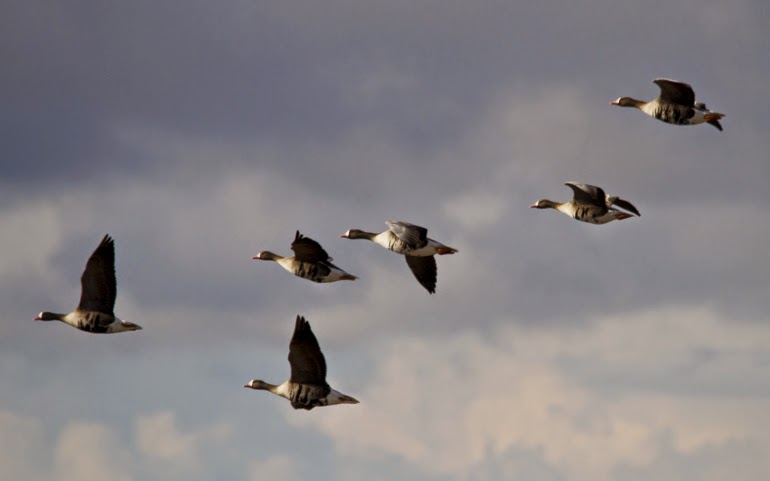
White-fronted Geese
Day 2 saw an early start as we headed back northwards for a spot of sea watching along the Poosapea Peninusla, after ticking a couple of male Montagu’s Harriers on route we were greeted by clear crisp blue skies at Spithami, thousands and thousands of migrating sea ducks blurred the horizon as huge numbers of Long-tailed Ducks took centre stage with smaller groups of Eider & Common Scoter also passing by. I made my first contribution to the group with a Red-backed Shrike spot as we left the shoreline and passed through some scrub. We headed back south along the forest roads stopping off for a walk at the wetland habitat of Sutlepa Meri, where an unbelievable 11 White-tailed Eagles soared low overhead. Red-necked Grebes in full breeding plumage called and shot off in every direction. A short section of boardwalk headed out into the reed bed itself where we were instantly surrounded by the booming of Bittern, a phenomenon neither of us had experienced before. Great Reed Warblers and reeling Savi’s Warblers called from every direction. After a fantastic rustic lunch on the shoreline of Matsalu Bay we headed straight up the adjoining observation tower, which offered fantastic views across the bay and its surrounding meadows. All teaming with water birds as thousands upon thousands of Barnacle Geese, along with a few Bean and good numbers of White-fronted Geese all paused from their northern migration. The marshland below the tower teamed with waders and large groups of Ruff in varying breeding finery trying to attract the attention of the accompanying Reeves.

Montagu's Harrier
Another early start found us out searching for Black Grouse and after a long drive down farm tracks and woodland roads we come out onto a large area of arable land where at least 30-40 males bubbled around in several different leks. Whooper Swan, Common Crane and Montagu’s Harrier were also seen on the fields. One of the more exciting lifers of the trip for both Kath and I came in the form of 6 unexpected Waxwings feeding in the pines on the edge of Lake Veskijarv, we also got a glimpse of our first Elk here too. After an afternoon of heavy winds and rain the evening brought clear skies and one of the most stunning sunsets I have ever seen, giving a great opportunity to photograph Haapsalu’s resident breeding Slavonian Grebes that were extremely tame, a real highlight for me.

Common Crane in a Snow storm
Haapsalu Sunset
Day 4 brought clear and sunny weather with some early morning excitement as Ortolan Bunting and Tree Sparrow were spotted outside of the breakfast room. Thrush Nightingale soon followed as we watched good flocks of passage Scaup out on the calm bay. We left Haapsalu and headed south towards Parnu ticking Greater & Lesser Spotted Eagle through some meadows on route, an abrupt end to lunch saw us another few kilometres down the road to the woodland meadows of Nedrema where Mati our guide had received a tip off of an Ural Owl. As soon as we pulled over this majestic Owl glided between the trees in perfect afternoon sunlight, one of my most memorable bird sightings ever. We continued on the last leg of our trip driving through the coastal marshes near Audru. The flooded marshes sit on the edge of Parnu Bay and were alive with breeding and migrant waterfowl, as far as the eye could see waders, gulls, hirundines and terns fed, flew and swam. Good numbers of Garganey, Pintail and Shoveler were found with Red-necked Grebe, Ruff, Spotted Redshank and Wood Sandpiper. Swallows clung to every stork of reed, and at least 2,500 Little Gulls joined them hawking around for insects.

Slavonian Grebe

Ural Owl
The next day an early morning start saw us head towards the Latvian border and with a crisp frost on the ground we found ourselves walking through the pre-dawn light inside a large area of clear fell woodland. Drumming Snipe perched on nearly every stump ending the silence with their ‘tick-tock’ calls. We added Wryneck to the list here, a species we had heard a lot during the week but a sighting, which kept eluding us until then. Kath and I both got a glimpse of Hazel Hen as its arse disappeared into the dense scrub. We soon got great views of a stunning Grey-headed Woodpecker as it called from the top of a nearby Aspen. After a superb lunch back in Parnu, Mati took us to some coastal grazing marsh on the edge of the city where in seconds we had five or more stunning male Citrine Wagtails perching all around us on the reeds and fence posts. I had a little wander on my own before everyone was calling for me to turn around really slowly, as I turned to find one of these bright yellow beauties less than 10 feet away on a post. A further jaunt down the coast took us to Pikla Pools one of my real highlights of the trip, these series of reed fringed pools and coastal meadows had a couple of great tower hides as we got good views of Penduline & Bearded Tit, Savi’s & Great Reed Warbler, Marsh Harrier, Peregrine, Great White Egret, White tailed Eagle and Red Fox. We also added Serin before the day came to the close with an unsuccessful owl trip in some nearby forestry.

Citrine Wagtail

After a long and tiring evening the day before, we were up early and off to our final destination of Tartu. Ticking our first and only Great Grey Shrike of the trip, a lifer Kath had to fling herself from the rear of the mini bus over 2 rows of seats ending up in the foot-well of the bus before getting a glimpse of. This was probably our quietest day of the trip and as our planned evening excursion to view lekking Great Snipe was cancelled due to an unusually dry spring we headed to the wetlands near Aardla. Watching a huge number of Ruff in all their finery feeding on the edge of a freshly drilled field. After climbing the rickety observation tower we were soon watching freshly arrived Black Terns hawking on the pools, large numbers of Bean and White-fronted Geese started to stream across the sky in front of the stunning setting sun. As the light started to vanish we watched 3 or 4 Beavers swimming across the open channels.

Tower at Aardla Wetlands
Our final full day of the trip saw another early start as we headed north to explore the bogs of 
Alam-Pedja. The woodlands were full of the song of Wood Warblers and we managed a brief glimpse of Golden Oriole. I thought I got a sighting of female Capercaillie in flight but we couldn’t re-find it so I was pretty disappointed, still a bird I’ve yet to see in the wild. A pair of photogenic White Stork greeted us at the mornings coffee stop. We headed back to Aardla in the afternoon for our final birding trip, finding even more Black Tern, Little Gull, Goldeneye and Red-necked Grebe. As we departed a pair of Marsh Harriers quartered the meadow low next to the road.

Crested Tit
Wood Warbler
White Stork


With an early afternoon flight back to the UK we headed back to Tallinn early in the morning concluding a thoroughly enjoyable break for all. On a personal level it was an awesome trip, I encountered 35 new lifers, and I know Kath managed more than me. The country of Estonia beat all expectations easily, it is a vibrant modern country with very few people, the road networks are immaculate, the hotels clean and comfortable and the people friendly. Its one of the few places I have been abroad were I have felt completely safe. And the food was to die for, not expecting too much as we were out and about a lot we had some fantastic meals. Simple well-cooked food takes some beating and I don’t recall having a bad meal at any of the hotels, restaurants or cafes we ate in.

 Our local guide Mati was full of great knowledge and made sure we all got to see a lot of what was spotted. David the ‘Naturetrek’ guide was equally as helpful if not more so and seemed to be able to tell any bird from even the slightest note of its call. As in any group of different people from mixed backgrounds you have some you like and get on with and there are often a few that you don’t and after taking at least till midweek to make sure everyone knew we were brother and sister not a married couple, this trip was no exception.  Mainly because a lot of guests wanted a lie-in in the morning and a nice break mid morning for Coffee. Maybe I was being selfish but having paid a small fortune to go on this trip I wanted to get the most out of it as possible and see all I could, but I think Mati and David did a pretty good job of keeping both camps happy. All in all Estonia in Spring was an awesome experience and I hope to go back one day to see the species we missed. 

If you are a social media user, Feel free to follow me on Facebook or Twitter for up to date sightings & photographs, any 'Comments & Criticisms' are welcomed.
Facebook  •  Twitter  

Thursday, 23 May 2013

Early March - 2013

To say March started with a bang for me was a bit of an understatement, another Patch Mega found its way into my notebook on the 2nd during a sunny saturday afternoon walk along the river. Taking my time as normal and giving the reed edge a good scan I totally missed the Bittern that erupted from the water edge about 3ft away, scaring me out of a good 10 years of my life, I quickly tried to setup my tripod, fumbling with my camera as this awesome mythical patch bird disappeared across the water meadows. As you can see from below I didn't manage a picture worthy of posting, but what a bird to have wintering on the patch about 300 yards from the front door.

This weekend also signalled the return of the Barn Owls to the water meadows, maybe I had just missed them throughout the winter but I manage to see two different birds hunting the long grass a good mile or so apart on both saturday and sunday afternoons.  

Distant Barn Owl
With my workload during the day starting to pick up due to our Tradeshow event at the NEC in April, finding time to visit Rooksbury Mill at lunchtime pretty ceased to exist, a trend that I still haven't had chance to remedy. So the odd evening I could sneak out on the river proved crucial in discovering the comings and going of spring.

Plenty of Duck life on the waterways with the Mallard Drakes starting to loose a little of the stunning colour they've held for most of the winter, Gadwall seem to be present in a lot higher numbers than throughout the past couple of months, showing up in groups of 6+ on various parts of the patch.

Mallard Drake
Gadwall At Dusk
The Goldcrests still seemed to be present everywhere as I counted a whopping 13 singing birds one evening on a river circuit walk, with the now daily increasing addition of Chiffchaffs that also got into double figures. The local Kestrels seemed to be quite active showing up quite often, along with a pair of Buzzards one with particularly pale coloration's.

Chiffchaff
One evening on the way home from work, I was positive I saw a lone Hawfinch rise up with the flock of Chaffinches feeding on the edge of the main road through the village, a quick look back for the next couple of nights confirmed that it must have just been a bloody big Chaffinch.

By the middle of the month a lot of Fieldfare and Redwing were showing up in the garden and around the fields surrounding the house, maybe fuelling up for there journey onwards, with several Redwing venturing quite close to the front room window for a stunning view one drab morning.

On the 16th Nat was down for the weekend so we took off down to Farlington Marshes, with reported sightings of Spoonbill & Red-breasted Goose over the past couple of days I thought it was about time I got some slight rarities on my year & county list. On a pretty drab day with plenty of rain in the air we soon picked up a white dot feeding on the far side of the reserve, Spoonbill or at least what looked like a Spoonbill. At this stage of the month there were still plenty of Brent Geese around Langstone Harbour as small skeins flew this way and that landing out on the mudflats and then coming back in again to feed on the grassy meadows.

If Brent Geese were still present in their thousands, Shelduck congregated in their hundreds, I don't think I have ever seen so many in one place. As we walked around to the far side of the reserve we spotted a strange Cape/Ruddy Shelduck hybrid sleeping in amongst the more striking commoners. This also gave us a better view of the Spoonbill now feeding on the shallow lagoon, brilliant to see it working its head back and forth bill under the water sifting through for food.

Incoming Shelduck
We encountered plenty of other species, Teal, Wigeon, Mallard, Stonechat, Bar-tailed Godwit, Little Egret, Sanderling, Dunlin, Kestrel & Sparrowhawk, but two new year ticks came as we almost made it back to the car, a female/juvenile Marsh Harrier rising up from the reed bed and spooking the thousands of Brent Geese that were feeding nearby, quite the sight.

If one stunning raptor wasn't enough we caught a quick glimpse of a female Merlin zooming between bushes further down the path. No Red-breasted Goose but well worth the visit.

With stomachs rumbling, a quick stop in Pizza Hut replenished the energy levels as we drove around the expanse of Langstone Harbour to the Spinnaker Tower and the seafront at Southsea. Having seen the reports on going birding for most of the winter I suddenly had the urge to try for what would be a new lifer for me, having not taking the species of birds I've seen throughout my life to seriously until a couple of years ago, I still have no recollection of catching up with this species before, the Purple Sandpiper, a winter visitor to our shores and one that doesn't visit in huge numbers. 

With high counts of 21 and 27 recorded during the winter, but none posted for a couple of weeks I wasn't sure if my luck would be in or not. So braving the now brighter but defiantly blowier weather we wandered along the promenade right up to the castle and believe it or not just 3ft the other side of the railings, 3 tiny little Purple Sandpipers hunkered down in any cracks they could find sheltering from the bitter wind. 

I never once imagined I would see them so close, and had to admit I was shocked by how they were to find. So as usual another good days birding down on the south coast.

Purple Sandpiper

If you are a social media user, Feel free to follow me on Facebook, Twitter or Google+ for up to date sightings & photographs, any 'Comments & Criticisms' are welcomed.
Facebook  •  Twitter  •  Google+

Saturday, 28 April 2012

A Black-headed Bombsite

With the cricket season here and the weather already proving a wash out, the first friendly was cancelled, so what to do with a unexpected free sunday? I know a trip down to the coast and Titchfield Haven NNR. The weather was still pretty indecisive and I must say any reserve that has enough hides to keep you sheltered from the frequent showers is good in my book.

The good thing about Titchfield is you park literally on the sea-front, the Solent merely feet away, plenty of action out on the waves but none of it anything other than Sailboats and Wind-surfers. On the opposite side of the road lies the Titchfield Haven reserve, a well managed and great location for watching wildlife, 6 Hides separated to 3 either side of the river that runs down into the Solent. The first thing that hit me though was the noise, thousands of Black-headed Gulls calling from the scrapes. A quick wander along the sea-front to the visitor centre and got my first glimpse of a pair of Linnets sat atop the surrounding gorse bush. Turnstones wandered up and down the footpath around the side of the small harbour totally unperturbed by the amount of human traffic. You often wonder when you turn up at these places, seeing the huge amount of cars and people if its going to be standing room only around the reserve, luckily nature didn't seem appealing to most, as once inside I probably only saw 10-15 people for the rest of the day.

The visitor centre side of the reserve has 3 hides overlooking the river and the water meadows. The usual Grey Heron, Cormorant, Mallard and Moorhen showed up on the river in the 1st Hide, the second two showing a bit more variety, a fairly biggish flock of Black-tailed Godwit grazed on the far side of the meadow, rising and falling regularly as they were often bombarded by Lesser Black backed Gulls.
Black-tailed Godwit
I did get quite excited about 15 minutes later when a stunning male Marsh Harrier (my first of the year) soared overhead spooking the Godwit flock and pretty much anything else within the vicinity. He landed briefly before being mobbed by 5 or 6 Carrion Crows, pretty rapidly disappearing back up the water meadows. Lapwing, Canada Goose, Teal and a Kestrel all showed well in the meadows as I sat dodging the rain drops in the hide.

A rather surprisingly nice lunch in the reserve cafe, and I was off out the other side of the river, All 3 hides over looking the scrapes and distant reed beds. It took a while to focus on any other birds as the Blur of Black-headed Gulls becomes more apparent. It would be hard to guess numbers but I'd say anywhere between 3000-4000 mostly paired off and nesting.


Just a narrow view of the Scrapes showing only a couple of Gull islands.

Once distinguished from the ever moving throng of Gulls, I spotted 9 feeding Black-tailed Godwit, 7 Avocet, Shellduck, Snipe, Shoveler, Gadwall, Oystercatcher, Herring Gull, Buzzard, Coot, Pheasant and a rather distant Fulvous Whistling Duck - a presumed escapee mingling with a couple of drake Mallard.

Black-tailed Godwits
Oystercatcher
Male Shoveler
So all in all a pretty a pretty good trip, with 35 Species logged, I'm sure there would be a few more if I could identify the bird song from the reed beds and trees. And an even bigger bonus I guess is I didn't get wet!